
Bardo · The Oath
Chapter 4
The Weir
Theo and Mira test Dunlow's official maps against stone, current, and frightened testimony, uncovering work someone chose not to record.
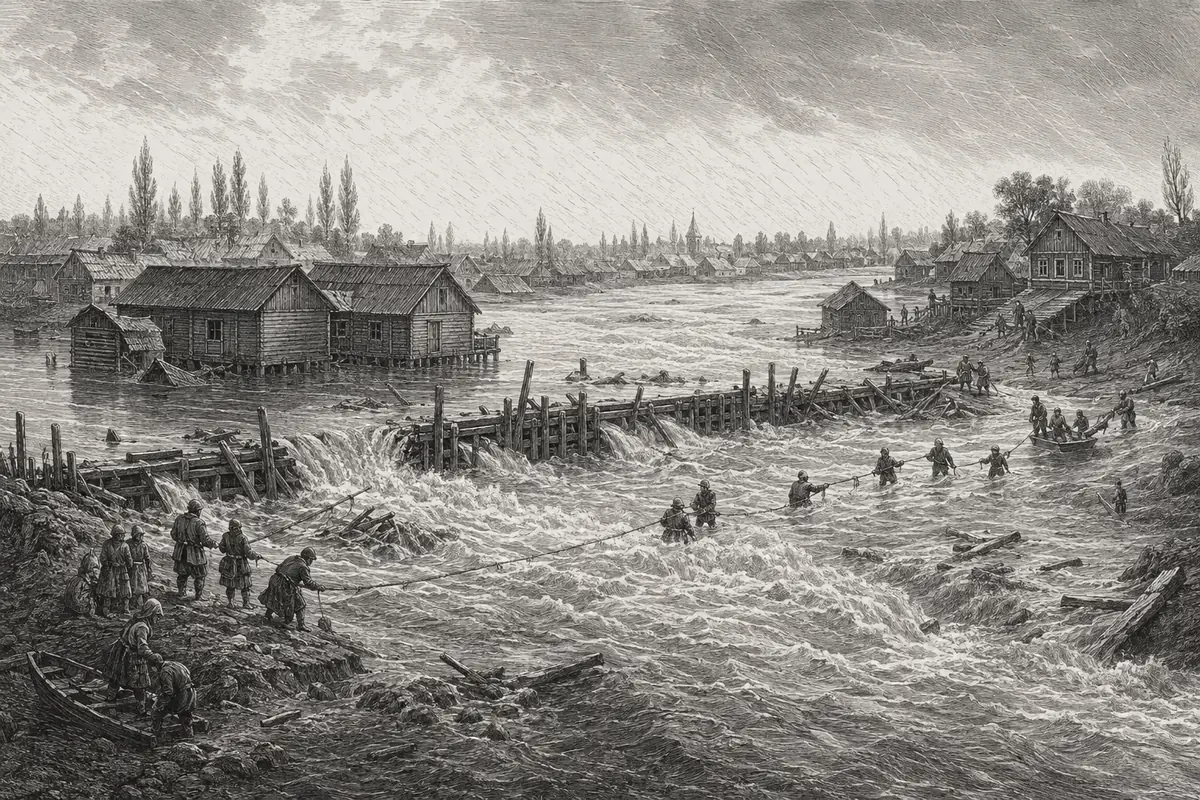
Dunlow’s water belonged to everyone until somebody tried to move it.
Then it belonged to six offices, two mill leases, the river wardens, three farming cooperatives, and whichever armed man stood nearest the gate.
Warden Parn explained this while leading Unit Twelve along the top of the old weir. Rain slicked the stones. On the upstream side, the river spread into a broad holding pool stained brown by field runoff. Downstream, controlled channels divided toward the mills and marsh drains.
“Main gates are town authority,” Parn said. “Mill races are maintained by the leaseholders. Field channels belong to the cooperatives within marked bounds. Emergency cuts require my seal.”
Mira walked behind him with the official diagram folded into a small square. “And subsurface culverts?”
“Old works. Closed.”
“Inspected when?”
“Before my appointment.”
“Which began?”
“Seven years ago.”
Mira opened the diagram again.
Theo carried a small testing frame assembled from a signal-board brace, three nails, waxed cord, and the patience of a supply clerk who had wanted none of it returned wet. Two cords were tuned an interval apart. A third hung loose for comparison. When he placed the frame against a wall or gate housing, vibration traveled into the taut lines and changed the beat between them.
It was not a Guard instrument. Maud had used something similar to teach him how a lute’s body distributed tension. Sabine had allowed it after making Theo write down what it could and could not establish.
“It shows repeated vibration,” he had said.
“Can it locate a defect?”
“Not alone.”
“Can it prove sabotage?”
“No.”
“Can it identify a mage?”
“No.”
“Good. Write those larger than the rest.”
At the west gate, Theo pressed the frame to the stone. The paired cords trembled. Their notes moved in and out of agreement, producing a slow pulse he felt behind his teeth.
“There,” he said.
Thomas put his palm beside the frame. “Nothing.”
“Watch the center cord.”
The cord blurred, steadied, blurred again.
Mira counted the changes. “Nine. Four. Eleven.”
“Not regular machinery,” Theo said.
Parn crossed his arms. “Water is irregular.”
“Not in the way your diagram claims.” Mira pointed to the paper. “The west holding wall should be backed by packed earth. Pressure through stone would damp quickly.”
“Unless the culvert is open,” Theo said.
The warden’s mouth tightened. “It is not.”
Sabine faced him. “Show us.”
The culvert access lay behind Hume North Mill, beneath a yard filled with timber, grain carts, and workers who stopped when the Guard entered.
The mill steward introduced himself as Arlo Venn. His coat was better than Parn’s and dry despite the rain.
“Lieutenant,” he said. “Mr. Hume regrets that illness keeps him at the south house. We have prepared the maintenance records.”
He held out a sealed packet.
Sabine accepted it. “We need the west culvert access.”
“Closed by charter.”
“Then access should inconvenience no operation.”
Venn smiled as if she had complimented the mill. “The yard is private leasehold.”
“The weir is under emergency inspection.”
“No emergency has been declared.”
Sabine looked toward Parn.
The warden cleared his throat. “Repeated flood conditions authorize inspection of connected works.”
Venn’s smile remained, but the person it had been for was gone. “Of course.”
He led them between stacked timber. Theo noticed workers watching Venn rather than the Guard. One woman shifted a shovel over a patch of ground darker than the surrounding yard.
Mira noticed too.
“Recent fill,” she said.
Venn did not turn. “We maintain our yard.”
“With marsh clay?”
“With available material.”
The access hatch stood beneath a lean-to, secured by a chain whose links carried fresh oil. Parn produced a key. It did not fit.
“Locks were changed after theft,” Venn said. “I can send for the yard master.”
Thomas drew one sword halfway. He did not threaten Venn. He placed the narrow back of the blade inside the chain, turned it against the scabbard mouth, and broke the weakest link with a small, ugly snap.
“Send for him,” Thomas said. “He may wish to improve the next chain.”
Below the hatch, stone steps descended into black water.
Nell tested the air with a lamp. The flame leaned inward and steadied. “Breathable. Slippery. If anyone falls, I will complain before treating you.”
Sabine left Parn and two watchmen above with Venn. Thomas went first, then Mira, Theo, Nell, and Sabine. Water reached Theo’s calves at the bottom.
The culvert was not closed.
A current pulled west through the passage. Tool marks shone pale on the stone where an old blocking wall had been cut open. Beyond it, new timber braces supported earth packed too loosely for age. Water threaded between the boards.
Mira held her lamp close. “Cut within the year. Maybe months.”
“Can you prove that?” Sabine asked.
“I can prove the marks are not seven years old. Wood source and tool width may narrow it.”
Theo set his frame against the passage wall. The cords jumped so hard one nail came loose.
The slow vibration was stronger here, joined by a second, quicker pulse. Water pressed through a space the official system did not admit existed, gathered behind fill, then released somewhere beyond the wall.
“This connects to the west gate,” Theo said.
Mira followed the current on her diagram. “And runs under the lower mill yard. If they opened it to draw more head—”
“We inspect before concluding,” Sabine said.
Thomas had moved to the timber braces. “These are marked.”
He wiped mud from one with his glove. A small burned stamp appeared: HH, crossed by a sheaf.
Hume Holdings.
Above them, the hatch slammed.
Darkness took the passage except for Nell’s lamp.
Thomas reached the steps in two strides. The hatch lifted before he touched it. Warden Parn stared down.
“Wind,” Parn said.
There was no wind in the lean-to.
Venn stood behind him, no longer smiling.
They spent the afternoon walking channels.
At the first field cooperative, three farmers blocked Hume’s drainage crew from entering a sluice yard. One carried a pruning saw, one a shovel, and one a baby wrapped beneath her coat. None wanted to fight the Guard. All expected the Guard to remove them.
“This gate feeds six winter plots,” the woman with the baby said. “Hume lowers it at night, roots freeze by morning, and Parn calls it flood control.”
Parn bristled. “I issue levels from mill readings.”
“Mill readings taken by Hume.”
The system did not require a conspiracy. It required one office to depend on data supplied by the person who benefited from it.
Sabine asked the farmers to demonstrate their ordinary gate schedule. Mira compared it to the company books. Theo set his frame against the sluice housing and heard the same returning pulse from the buried drainage bed.
The baby woke and began crying. Hume’s crew chief looked toward Venn for instruction. The farmers looked toward Sabine. Everyone had made the lieutenant the hinge.
“No gate changes until the weir inspection establishes a safe level,” Sabine said. “Farmers retain access. Company crew may observe and record. Warden Parn, readings come from both mill and cooperative gauges starting tonight.”
Nobody received everything. The farmers lowered their tools. Venn’s crew remained, denied control but not expelled. Parn acquired more work and less plausible ignorance.
As they left, the woman caught Theo’s sleeve. “Evan told us the old bed was filling.”
“Why didn’t you report that?”
“We did. To Parn.”
The warden heard. His face changed.
“When?” he asked.
“First flood.”
Parn turned to his deputy, who had logged the complaint as unverified mage agitation and never placed it in the water file.
Mira added the complaint route to her map. A failed message could move as much water as a cut channel.
Sabine separated the questions carefully. Hume timber in an illegally open culvert proved unrecorded work. It did not yet prove the work caused every flood. It did not prove Venn had shut the hatch. It did not prove Evan Moss innocent of opening other gates.
Theo understood the discipline and resented how convenient it was for people with time.
At the lower mill, a broad spillway fed three wheels. Workers cleared reeds from iron screens while Venn followed the unit with a clerk who recorded every question Sabine asked.
“If the culvert increased your water head,” Theo said to Venn, “production records should show a change.”
“The musician is now a mill accountant?”
“No. That is why I asked for records instead of composing an answer.”
Venn’s clerk looked down quickly. Thomas did not.
Sabine said, “Production books. Twelve months.”
“Commercially protected.”
“So is the water behind your yard.”
That earned them the books, though not without a message sent to Walter Hume.
Mira left the spillway and climbed the west bank. Theo saw her stop beside a row of pollarded willows. Their lower trunks were crusted with old silt on the river side. Three newer trees had been planted in a shallow curve.
She drove her probe into the ground. Once, twice. On the third push it sank to the handle.
“Recent earthwork,” she called.
They joined her. Beneath a thin skin of turf lay wet, uncompacted fill. The curve ran toward a field channel shown fifty yards east on the official diagram.
Parn stared at it. “That channel was never moved.”
Mira handed him the probe. “Then Dunlow has started growing false ground.”
One of the mill workers laughed before fear stopped him.
Theo recognized the woman with the shovel from the yard. She looked from Venn to the Guard and lowered her eyes.
He approached slowly. “You work the west yard?”
“Where I’m put.”
“Were you put here when this was filled?”
Venn spoke behind him. “Employees are not required to answer speculative questions during their shift.”
Theo kept his attention on the worker. “You are not required to answer me. You may also speak to Lieutenant Holt privately.”
The woman gripped the shovel. Mud had split the skin across her knuckles.
“Evan opened it,” she said.
Venn went still.
“Opened what?” Theo asked.
“The cut. At night. We saw him at the north channels. He opens what he’s forbidden to touch.”
“Who is we?”
She glanced toward the mill windows. “Workers.”
“Why would he open it?”
“Because he’s a mage.”
The answer arrived too quickly. It was a label where a motive should have been.
Theo softened his voice. “What did you see him do with the water?”
“I saw him at the gate.”
“And the water?”
“Afterward it was lower.”
Venn stepped closer. “There is your saboteur. Shall we continue measuring mud while he floods another district?”
Sabine looked at the worker. “Name?”
“Cora Bell.”
“Cora, you will be paid for the remainder of this shift from emergency funds. Warden Parn will provide a room where you can give a complete statement without your employer present.”
Venn’s clerk began writing furiously.
Cora’s grip loosened on the shovel. “My sister works south mill.”
Her hesitation had a price: her sister’s work.
Sabine said, “We will record that too.”
Mira marked the new channel on her map. Theo watched Venn watch her do it.
By dusk they had two incompatible facts. Hume Holdings had altered the water system and omitted the work from records. Evan Moss had been seen opening forbidden channels after dark.
The town wanted one cause it could arrest.
Water moved through every cause available.
They found the first sign of Evan beyond the last mill house: boot prints on a narrow maintenance bank, one heel worn inward. Mira crouched over them as rain began again.
“Recent,” she said. “He is moving toward the marsh.”
Warden Parn touched the warrant inside his coat. “I can bring eight men.”
Sabine looked at the darkening channels and the workers gathering behind the mill fence.
“Four Guard are enough,” Parn pressed.
“Five,” Theo said.
Sabine ignored both numbers. “No town watch. No mill employees. If Moss is frightened, a crowd will turn flight into violence.”
Parn’s face reddened. “He has defied my authority for weeks.”
“Then he already knows your methods.”
Thomas checked his sword straps. Nell filled two flasks. Mira drew the marsh route on a wax board.
Theo packed the testing frame. One cord had stretched in the culvert and would no longer hold pitch. He replaced it with a spare lute string.
The string was finer than the others. When he tightened it, the note rose cleanly above the rain.
From somewhere beyond the reed line, another note answered: a gate hinge turning under pressure.
Then came the sound of running feet.
Sabine raised one hand. Unit Twelve moved into the marsh.