
Bardo · The Oath
Chapter 5
Evan Moss
In Dunlow's marshes, Theo finds the accused man and must choose how much faith to place in testimony the Guard cannot verify.
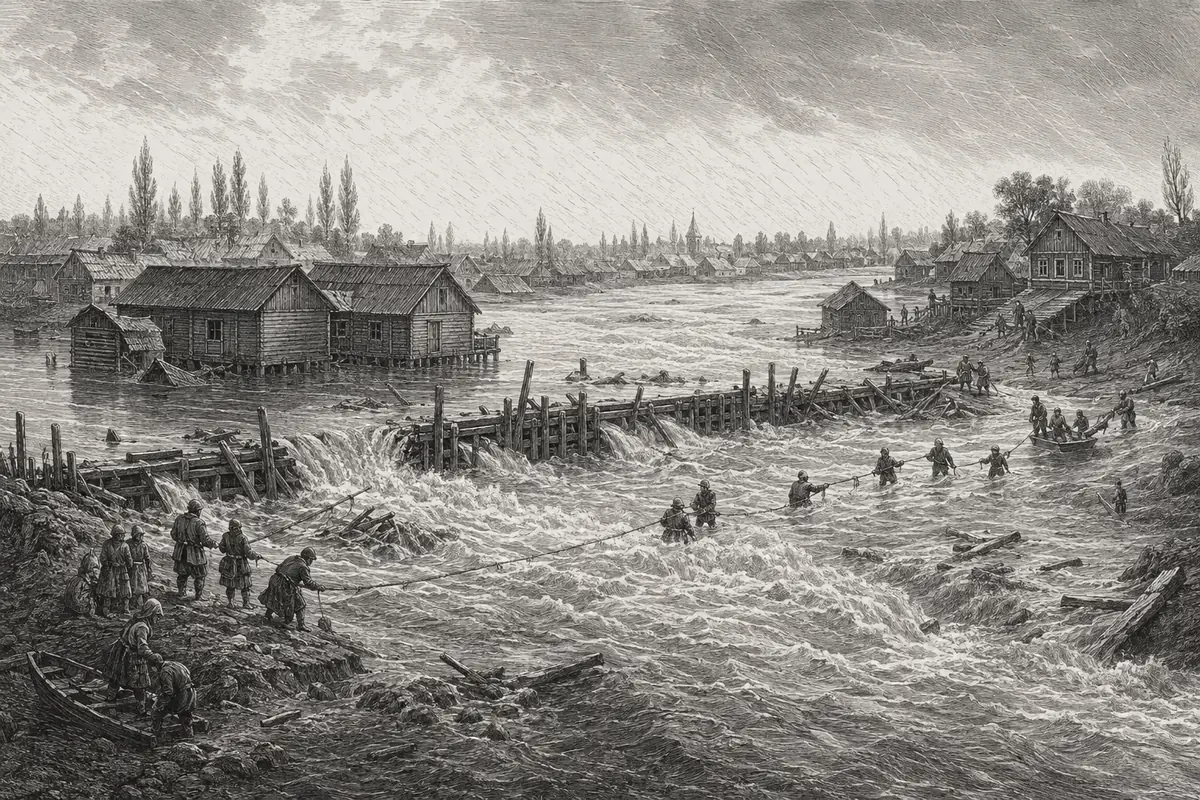
The marsh kept paths the way dishonest witnesses kept promises: clearly until somebody depended on them.
Mira led along a raised bank no wider than Thomas’s shoulders. Black water moved on both sides beneath mats of duckweed. The last mill lamps disappeared behind rain. Ahead, reeds clicked together in the wind.
Evan Moss’s prints ended at a maintenance gate.
The gate stood open. Water slid through it toward a channel marked closed on every map they carried.
Thomas examined the chain. “Cut.”
Mira touched the bright metal. “Today.”
“By him?” Theo asked.
“By a tool.”
Sabine pointed to a strip of cloth caught on the hinge. “Nell?”
Nell turned it under her lamp. Brown wool, rough and wet. A dark stain ran along one edge.
“Blood,” she said. “Not much.”
A splash sounded beyond the reeds.
Thomas drew both swords. Sabine signaled wide approach: Thomas left, Mira right, Nell hold center, Theo with her. Theo slipped a brass whistle from his collar and immediately felt foolish. A whistle announced position. It did not explain intention.
“Evan Moss,” Sabine called. “Charter Guard. We are here to inspect the channels and hear your account.”
“You brought swords to listen?” a man answered.
The voice came from their right. Thomas had already turned toward it.
“Swords came with the person,” Sabine said. “He is difficult to separate from them.”
“Try.”
Thomas’s expression suggested he would welcome the experiment.
Theo listened past the rain. Reeds scraped cloth ahead. Water lapped a bank to the left. The reply had come from the right because Evan wanted Thomas moving that way.
Theo faced the dark ahead. “Your boot is bleeding.”
Silence.
“The south bank has broken shell in the mud,” Theo continued. “If you keep running, the cut will widen.”
“Then stop following.”
“We need to know why you opened the gate.”
“Because it needed opening.”
“That answer has caused trouble before.”
“Only for people downstream.”
Sabine glanced at Theo. He heard the instruction in it: keep him speaking, do not promise.
“The Hume culvert is open,” Theo said. “Their timber is inside. We found fresh earthwork where the map shows none.”
Reeds moved directly ahead. A man stepped onto the bank with a hooked gate tool held across his body.
Evan was perhaps thirty, narrow-faced, with rain-plastered brown hair and a beard grown by neglect rather than design. His left boot had split at the ankle. Blood diluted into the water around it.
His gaze moved over their collars, stopped at Sabine’s bars, then dropped to the white bridge arch.
“You found it,” he said. “And still came for me.”
“Both can be evidence,” Sabine said.
“One has offices.”
“Put down the tool.”
“So you can assess me?”
The word changed the marsh. Theo heard Cora’s quick answer: Because he’s a mage. He heard the records clerk stamping his foundling page. Assessment could mean a score, a lawful inquiry, an honest measure.
Evan heard something else.
“We need to secure the gate,” Sabine said. “And your injury.”
“Then secure the gate.”
He backed away.
Mira appeared behind him without a sound. She did not block the path. She stood where he could see the gap between them.
Evan turned toward her, then toward Thomas. The gate tool shifted in his hands.
Theo said, “If you swing, they will win the argument before you make it.”
Evan looked at him. “You think this is an argument?”
“I think you want us to understand the weir before somebody decides your fear proves guilt.”
“My fear proves I have met the Guard.”
Sabine did not react to the insult. “What changed at the weir?”
For the first time, Evan hesitated because of the question rather than the badges.
“Hume cut the old west culvert,” he said. “Wanted more fall at North Mill. It drained the holding earth behind the gate. Then they filled a field channel to hide the extra draw.”
“You worked there,” Theo said.
Evan’s gaze shifted to the Hume stamp on Thomas’s field note. “Gate crew.”
“Why were you dismissed?”
“I refused the second cut.”
“Because it was unsafe?”
“Because I could feel the load leaving the gate bed.”
Sabine’s attention sharpened. “You told them that?”
“I told the engineer the stone would lose support. He asked how I knew. I made the mistake of answering.”
“Did you demonstrate?”
“Small. A bucket line. Enough.”
“Who witnessed it?”
“Engineer, Venn, three crew. By evening I was dismissed for intoxication. By the next week, Parn had an anonymous report that I threatened the mills with water.”
Theo heard a causal chain they could test. Employment record. Dismissal reason. Anonymous complaint timing. Named witnesses.
“Give us the engineer’s name,” he said.
“So Marr can put him in the same wagon?”
The name struck before Marr had entered the story in person.
Sabine said, “Why Owen Marr?”
“He took my uncle.”
“When?”
“Nine years ago.”
“What ability?”
Evan tightened his grip on the tool. “He could feel groundwater through stone. He found wells. He found a collapsed child before the rescue crew dug the wrong room. Guard called him useful until a district lord wanted a spring routed through private land.”
“And abatement?” Theo asked.
“Assessment first. Always assessment first.”
This was testimony shaped by family loss, fear, and perhaps truth. Theo wanted to believe every part because Hume’s culvert already made Evan right about one thing.
Mira said, “Your uncle’s name stays out of the field log unless it explains current evidence.”
Evan looked at her with surprise.
“Why?”
“Because you did not consent to make him useful to this case.”
For the first time, he looked at Unit Twelve as separate people rather than one coat with five bodies.
“Why do the floods recur?” Mira asked.
“Because the fill dams the west drainage. Pressure builds behind it until the ground gives. I open the night cuts to lower it.”
“Show us,” Sabine said.
“No.”
“You want inspection.”
“I want the town alive. Inspection is what you do before taking me.”
Nell stepped forward. “Your foot needs cleaning.”
Evan almost laughed. “Does everyone in your unit speak as if I am already in your wagon?”
“I speak as if mud enters cuts whether or not you respect my authority.”
His grip on the tool eased by a fraction.
Theo saw an opening. “Take us to the pressure line. You remain ten paces ahead. Thomas sheaths the swords. Nell treats the foot when you choose. We inspect before custody.”
Sabine’s head turned.
Theo had not promised freedom. He had arranged sequence.
Evan watched her. “Can he bind you?”
“No,” Sabine said.
Theo felt the answer as a small public cut.
“But I can accept the inspection order,” she continued. “Thomas.”
Thomas sheathed both blades.
Evan lowered the tool. “Ten paces.”
“Eight,” Mira said. “The bank forks ahead. At ten you can disappear.”
“Nine.”
Sabine nodded.
They moved.
The pressure line was not a line. It was a crescent of drowned pasture beyond the Hume embankment, where water had risen through the grass in dozens of small, clear boils.
Evan stopped at the ninth pace and pointed with the gate tool. “Under us is the old drainage bed. They filled the west end. Every mill release pushes into it.”
Mira opened her map on an oilskin board. “The bed continues south.”
“Used to.”
“How do you know where the pressure sits?” Sabine asked.
Evan’s eyes hardened. “I walk here.”
“That is not enough to place every boil.”
“It is if you have walked it since childhood.”
Theo heard the lie—not in pitch, because people did not become instruments merely because he wished them simpler, but in structure. Evan had answered a question about precision with a claim about familiarity.
Sabine heard it too. “What can you do?”
Rain struck the standing water.
Evan looked at the open routes around him. Thomas stood to the north. Mira had moved south to inspect a boil. Nell waited with bandages. Theo and Sabine held the bank behind.
“I open gates,” he said.
“Without touching them?”
“With a tool.”
“Cora Bell says the water was lower after you entered restricted channels.”
“Cora’s sister works for Hume.”
“That explains cost, not falsehood.”
Evan’s mouth twisted. “You sound reasonable. They choose the reasonable ones for this.”
“For what?” Theo asked.
“To make the wagon feel like help.”
Nell crouched by a clear boil. She put a strip of dry reed on the surface. It spun twice, then shot sideways.
“Current underneath,” she said.
Mira drove her probe into the ground. Water surged around it.
Theo set the testing frame against a half-drowned fence post. The fine lute string thrummed high. Under it, the heavier cords produced a broken pulse that traveled south, returned, and struck again.
“It is reflecting,” he said.
“From the fill,” Evan answered before stopping himself.
Theo looked toward him. “You hear it?”
“I feel the ground.”
“Show me where it returns.”
“Why?”
“Because if your account is right, we can put measurements in the report. Not suspicion. Not mage. A place, a direction, a change.”
Evan stared at the frame.
“Reports,” he said. “Jonas Rell had reports.”
Theo’s hand slipped on the wet wood. “You knew Jonas?”
“Everybody on the north waterworks knew what the Guard said he did.”
“That isn’t what I asked.”
Evan stepped into the pasture. Water reached his ankles, then shins. “Your string is pointing wrong.”
He used the hooked tool to draw a shallow curve through the water. “Pressure comes from there, catches the buried wall, splits. One part returns to the gate. One moves south under the fill.”
Theo shifted the frame. The beat strengthened exactly where Evan indicated.
Mira marked the curve.
Sabine said, “This is useful evidence. Come back to town. Give a full statement. We can separate the infrastructure charge from the ability assessment.”
Evan looked at her with exhausted pity. “No, you can’t.”
“Individual assessment is required.”
“And abatement?”
“Depends on the finding.”
“Have you met anyone after?”
The rain filled the silence.
Theo thought of procedure as a bridge. Each answer should have laid another plank. Instead Evan had reached a place Sabine could not cross from evidence.
“I haven’t,” she said.
“Neither have I.”
Evan backed deeper into the pasture.
Thomas moved. Evan thrust out one hand.
Nothing visible happened. Yet the water around Thomas’s boots tightened into a sudden current. It pulled sideways, enough to force him down on one knee. At the same instant, water drained from around Evan and rose along a channel toward the reeds.
Thomas recovered and drew a blade.
“Hold,” Sabine ordered.
Evan ran.
Mira followed two steps, then stopped. “Ground is failing.”
The clear boils had multiplied. Across the crescent, pasture lifted in low blisters.
Theo’s frame screamed against the post. The fine string snapped.
From the direction of the weir came a deep report, too large for thunder and too close to mistake.
The standing water rose over Theo’s boots.
Evan turned in the reeds. Terror had stripped every argument from his face.
“It is early,” he said.
Another report rolled beneath them.
“What is?” Sabine demanded.
Evan pointed toward Dunlow.
“The west ground. It has gone.”