
Bardo · The Oath
Chapter 16
The Reprimand
Theo faces discipline for Derrin and learns that accepting the harm he caused does not require pretending the withdrawal was just.
The formal reprimand used the word deviation six times and death once.
Theo read it in Review Chamber Two at North Coast Command. Sabine sat to his right. A regional adjudicator sat across from them with the Derrin maps, signal log, withdrawal order, medical reports, and statements from every member of Unit Twelve.
“Do you dispute that Lieutenant Holt issued a direct withdrawal command?” the adjudicator asked.
“No.”
“Do you dispute that you understood it?”
“No.”
“Do you dispute crossing the rescue perimeter after receiving it?”
“No.”
“Did you believe communication with your field commander was impossible?”
“No.”
The questions reduced Derrin to a line as clean as the one omitted from Mira’s maps. Theo had crossed it.
“State your reason.”
“The north pocket reported failing air. I saw a route to couple the existing hose to the old ventilation pipe. I believed we could extend their survival without continuing excavation.”
“Lieutenant Holt rejected that route?”
“She rejected crossing the line.”
“You distinguish them.”
“The miners would.”
Sabine did not move.
The adjudicator turned to Nell’s statement. “Your action caused two other unit members to cross after you.”
“They chose to follow.”
The answer sounded wrong as soon as it left him.
“Did you expect support?”
Theo thought of running toward the raise. Had he imagined doing it alone? No. He had not imagined at all. Somewhere beneath intention, he had trusted that Unit Twelve would keep him from failing.
“Yes,” he said.
“Then their choice was part of the risk you accepted.”
“I did not accept it for them.”
“You relied on it.”
The adjudicator was not cruel. That made evasion harder.
Theo looked at Mira’s medical report: shoulder strain, fourteen days restricted movement. At Thomas’s powder burns. At Nell’s damaged airway kit. At the note that the hose, once severed, could not be recovered or repaired.
“Yes,” he said. “I relied on them following.”
The adjudicator folded his hands. “Do you believe the withdrawal order was correct?”
Sabine’s eyes turned toward Theo.
“No.”
“Do you believe Lieutenant Holt acted lawfully?”
“Yes.”
“Do you believe your action was justified?”
Theo wanted a word that preserved the miners, blamed command, honored Mira’s choice, apologized to Nell, and kept himself the person who did not walk away.
No such word had survived the slope.
“I believe the attempt had a defensible aim,” he said. “I believe I imposed costs I had been ordered not to impose. The hose failed because we were there under fire. I do not know whether the extra air would have saved anyone. I know crossing nearly trapped my team.”
“That is not an answer.”
“It is the answer I have.”
The adjudicator read the reprimand into the record. Theo would remain a probationer, lose independent field discretion for three months, repeat command-judgment assessment, and serve temporarily in low-risk Signals and Dispatch assignments. Another violation could end his Guard service.
Sabine signed as field commander.
Theo signed beneath her.
His name authenticated the finding this time.
Joanna met him on the western wall after review.
Ternwick lay below: harbor masts, slate roofs, the long line of Lantern Quay rebuilt in pale timber. From Command ridge, the city looked like a system that agreed with itself.
“If you’re here to say courage without judgment makes others pay,” Theo said, “the adjudicator used more pages.”
“I read them.”
“Do you agree?”
“With the facts.”
“Not the order?”
Joanna rested both hands on the wall. “Regional Command faced armed escalation. Sabine faced command, local forces, trapped civilians, and a unit whose safe withdrawal she owned. You faced a rail with a person at the end. Each field was real.”
“That is a careful way not to answer.”
“You still believe an answer can make the fields become one.”
“Should we have left?”
“We should have prevented the mine from stealing across a disputed border, the company from hiding unsafe quotas, and two governments from using workers as territorial markers. By the time you held the hammer, every available decision spent lives.”
“Then what was the right one?”
“There may not have been one.”
“That sounds like permission for rank to choose whatever it wants.”
“No. It means rank is accountable for the choice it makes, and so are you.”
Theo looked toward Lantern Quay. “Will the Guard investigate the production quotas?”
“Yes.”
“Will it challenge the withdrawal?”
“Command review is open.”
“Will it recover the miners?”
“Veyr reports twelve bodies recovered and two survivors from an isolated pocket. Names are pending confirmation.”
Theo gripped the cold stone.
Tomas could be one of the two. Or one of twelve. Or still under a word like pending.
“I told them we would stay.”
“Why?”
“Because they needed to believe someone would.”
“And because you needed to be the person who did.”
He turned on her. “You think this is vanity?”
“I think vanity can stand beside compassion without making compassion false.”
The harbor wind moved her coat against the wall.
“You wanted recognition before you wanted the badge,” she said. “That is not shameful. Service deserves recognition. But when your identity depends on being the one who refuses to leave, withdrawal becomes impossible even when staying makes someone else the sacrifice.”
Theo thought of Mira’s coat in his hand. Nell’s fingers locked around his belt. Thomas standing between rifles with swords drawn wide.
“I am sorry,” he said.
“To me?”
“No.”
“Good.” Joanna stepped back. “Remorse is not repair. Ask what changes in your next decision.”
“And if the next order is wrong?”
“Then disobedience may be required.”
Theo stared at her.
“You expected me to say never?” Joanna asked. “The oath does not exempt rank. But disobedience is not made righteous by intensity. You must know the cost, choose which part is yours, and stop borrowing other people’s courage without consent.”
She left him on the wall with a lesson less comfortable than obedience.
Repair began badly.
Nell refused his apology in the infirmary corridor.
“You gave it yesterday,” she said. “I heard it.”
“I want to explain—”
“That is why I am refusing.”
She handed him a requisition for the damaged breathing manifold. “Replace the kit. Then learn what it is for before you ask me to sacrifice it again.”
Mira accepted his apology but not his offer to take sole responsibility in the record.
“My choice remains mine,” she said, adjusting the sling. “Your pattern remains yours. Those can both be true.”
Thomas met him in the practice yard. He placed two wooden swords on the ground.
“I am restricted from field discretion,” Theo said.
“This is a yard.”
“My sword work will not improve your opinion of me.”
“My opinion is not the exercise.”
For an hour, Thomas taught him how to retreat while facing danger. Theo discovered it required more discipline than advancing and hurt in less dignified places.
Halfway through, Nell entered the yard with Mira. Mira’s shoulder was still strapped; Nell had brought her to walk the perimeter as part of recovery.
Thomas demonstrated the backward step again. “Weight leaves before pride.”
“Your teaching language is becoming poetic,” Theo said.
“You are concussed by shame.”
Mira watched Theo repeat the movement. “He turns toward whoever is behind him.”
Thomas stopped. “Yes.”
“At Derrin he turned toward the shaft, not us.”
Theo lowered the wooden sword.
Nell said, “That is the point.”
The lesson shifted. Retreat was not moving away from danger. It was maintaining awareness of the people whose movement depended on yours. Thomas had built a physical exercise around a relationship failure. Mira had corrected it from the edge. Nell had named the connection.
Theo practiced until he could step backward without losing either Thomas in front or the three people behind.
Afterward, he replaced Nell’s breathing manifold from his own stipend. She opened the package, inspected the fittings, and returned half the cost.
“Why?” he asked.
“Because I chose to use it.”
Mira paid a quarter for the same reason. Thomas paid nothing.
“I cut the guide line,” he said. “That was correct.”
It was the most honest division of responsibility Theo had encountered since Derrin.
At Avelos House, his family read the public reprimand before he could explain it. The harbor notices had carried a shortened version: probationer disobeyed withdrawal, border incident worsened, rescue equipment lost.
Corin wanted to hire an advocate. Alden refused to use family influence before Theo asked. Maren read the casualty list and the reprimand side by side.
“Did you do what it says?” she asked.
“Yes.”
“All of it?”
“It leaves out why.”
“That was not my question.”
Theo told them about the hose, the shot, Mira’s shoulder, Nell’s manifold, and the miners. Nobody in the family agreed on the decision. Tessa said she would have followed him and resented him for knowing it. Corin said command had abandoned the workers first. Alden said both facts increased Theo’s obligation rather than canceling it.
Maren took the brass evacuation token from the table and placed it in his palm.
“You have always been good at making people move,” she said. “Learn to ask where.”
The family did not withdraw love or manufacture absolution. Theo returned to Command with both intact.
Sabine assigned him a sealed-dispatch run two days later. A storm had damaged the northern signal line; routine command packets had to reach three relay houses by road. Low risk. No contested authority. No trapped miners.
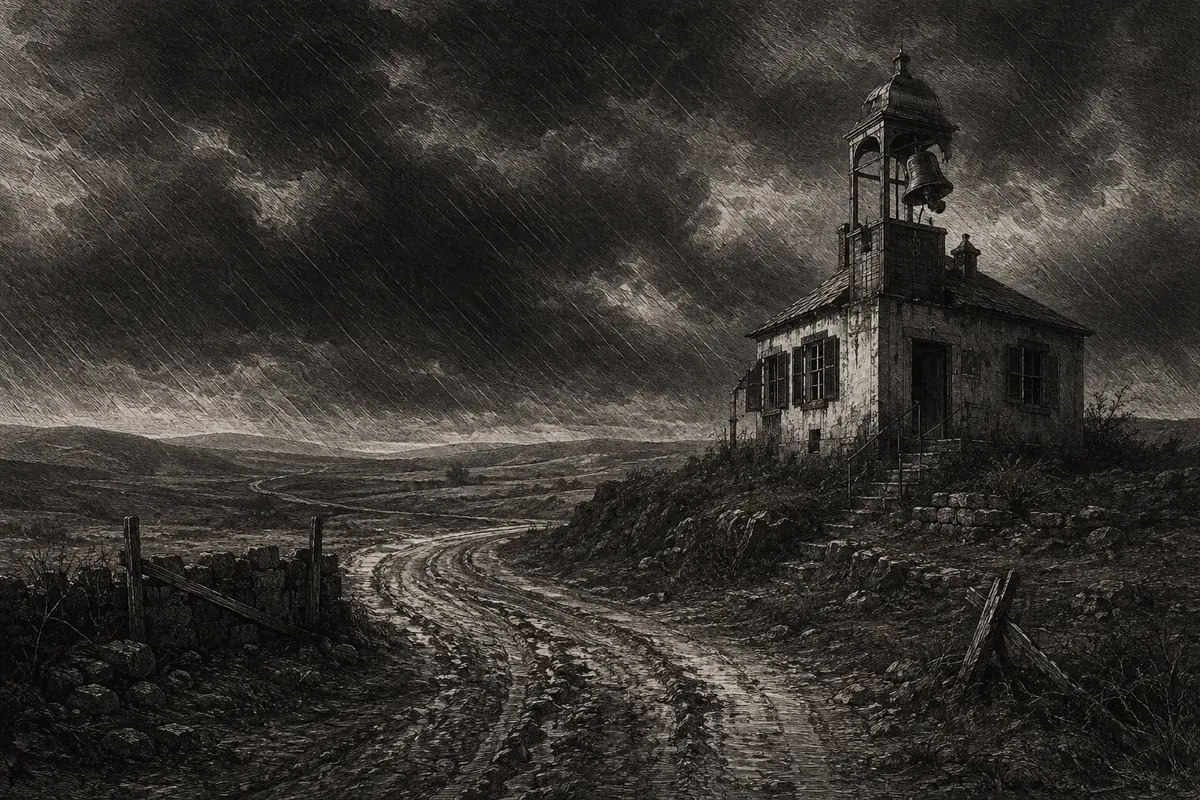
She spread the route ledger between them. Two occupied houses stood on the main road. The third packet belonged at Gannet Relay, beyond the point where the broken line stopped reporting. If Gannet had closed, the printed contingency sent couriers six miles east to Morrow Bend, an old station retained as public storm shelter after its bell was disconnected.
“The closure board was current yesterday,” Sabine said. “The line failed after midnight. If conditions have changed, follow the posted road markers. Do not improvise a shorter route.”
Theo studied the signatures. Signals had confirmed the ledger. Roads had cleared the patrol. Sabine had countersigned both. Nothing in the assignment depended on trust in his instincts.
“Alone?” Theo asked.
“The route is patrolled. You remain on the road, lodge at marked houses, and do not open sealed packets.”
“What if someone calls for help?”
Sabine held out his signal whistle. “Use judgment.”
He took it.
Their fingers did not touch.
The first day passed without incident. Theo delivered two packets, slept badly at a relay lodge, and left before sunrise under a sky the color of slate filings.
By afternoon, weather moved in from the hills. Wind tore branches across the road. At the Gannet turn, a fresh red board barred the western track: roof damage, house closed, no lodging. The notice bore the local road seal and had been posted that morning—too late to cross the broken line before Theo left Command.
Below it, the contingency arrow pointed east.
Morrow Bend was not a secret path or a tempting shortcut. It was the approved shelter in the approved ledger, reached because weather had changed faster than damaged signals could report it.
He reached it after dark with rain running inside his collar and Joanna’s words returning at every mile.
Know the cost. Choose which part is yours.
The old signal house should have been empty.
Light showed beneath the door.