
Bardo · The Oath
Chapter 17
Morrow Bend
Seeking shelter at an abandoned signal house, Theo finds two Examiners holding a young woman beyond the protection of ordinary procedure.
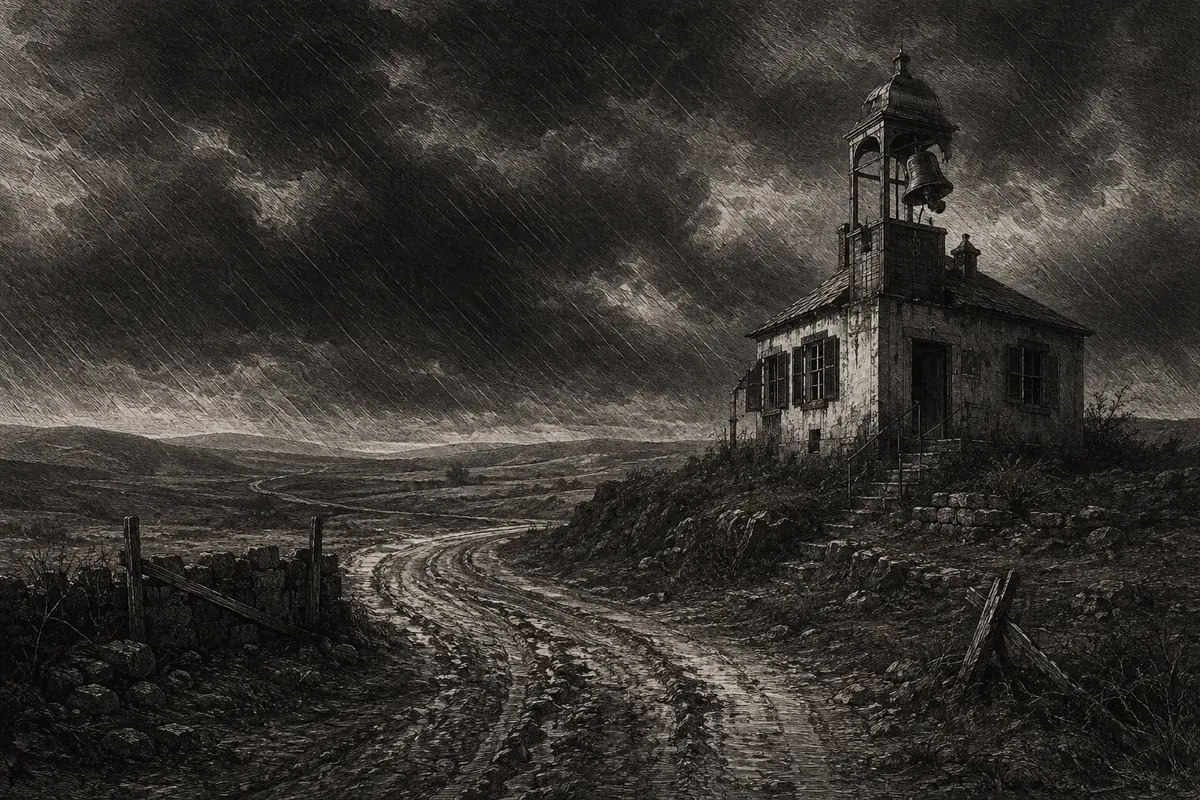
Theo knocked because the law required courtesy before entry and because someone inside had dragged a chair against the door.
The chair scraped.
A man said, “Occupied.”
Rain drove along the road in silver sheets. The old signal house had no stable, no neighboring light, and one shutter beating loose above Theo’s head. His route cloak had stopped resisting water an hour ago.
He showed his badge to the narrow opening. “Charter dispatch. The northern relay is closed. I need storm shelter until the road clears.”
The man looked at the probationer mark, then at Theo’s sealed case. He had a broad, clean face and a bruise darkening one knuckle.
“House is under Inquiry use.”
Theo saw the black-glass pin at his collar.
“Examiner,” he said.
“Owen Marr.”
The name sat in Evan’s transfer file.
Theo kept his recognition out of his face. “Do you have an operational closure posted? The road marker showed public shelter.”
Marr began shutting the door.
Someone inside knocked over metal.
Not a dropped cup. A chain pulled tight.
Theo put his boot against the door.
Marr looked down at it. “Remove that.”
“Is someone detained?”
“Remove your foot, probationer.”
Theo considered the field. Alone. Restricted discretion. Two sealed command packets in his case. An Examiner with authority above him and a person he could not see.
He moved his boot.
Marr shut the door.
Theo stood in the rain for three breaths.
Then he walked around the house.
The east shutter had lost one hinge. Through the gap, he saw a lantern, two men in Guard coats, and a young woman tied to a chair.
She was tall even seated, with dark hair braided close for travel and pointed ears half-hidden by wet strands. Blood marked one corner of her mouth. Her gray cloak was plain. At the cuff, where the outer cloth had torn, a line of gold and blue embroidery showed against the lining—fine enough to belong in a court room, hidden where no casual eye would price it.
The second Examiner stood beside her holding a packet of papers.
“Route from Lorness to which port?” he asked.
The woman answered in careful Charter speech. “I have given you my destination.”
“A false one.”
“Then you have saved us both time by deciding.”
The Examiner struck the papers against her shoulder, more irritated by tone than silence.
Theo returned to the door and knocked again.
Marr opened it with his hand already on a short club.
Theo held his badge up. “I require the detention warrant and use order for this shelter.”
Behind Marr, the second man laughed.
“Lewis Baird,” he said. “Examiner. You may write both names in whatever report survives the rain.”
“The warrant,” Theo repeated.
Marr opened the door wider. “Come out of the weather.”
The invitation was not kindness. It moved Theo where they could close the road behind him.
He entered anyway.
The signal house had one main room, a loft, and an equipment alcove stripped of everything but rusted supports. A relay bell hung overhead. Wind moved its clapper without enough force to sound.
Theo set his dispatch case by the door but kept the strap over one shoulder.
The young woman looked at him once. Her eyes were green-gray and very awake. She did not ask for help.
She looked instead at the sealed dispatch case, the water running from Theo’s cuffs, and the care with which he favored his left side when breathing. The examination was as deliberate as his own.
“He is under field restriction,” she said to Marr.
Theo’s attention snapped to her.
Baird smiled. “You see why conversation is fruitful.”
“How do you know?” Theo asked.
“The whistle cord is probationary issue, but the field tab has been removed. Your coat shows recent wear at the collar and no unit mud. Either you were promoted into a desk or disciplined out of the road.”
“And which?”
“You came inside.”
Marr struck the back of her chair with his club. “Enough.”
She had used him. By reading Theo aloud, she made the Examiners reveal how much they knew and warned him that his authority was thinner than his coat suggested.
Theo stepped nearer the fire, where the room opened around him. “If you know Guard issue, you know detainees receive water and injury assessment before continued questioning.”
“I know your procedures,” she said. “They have been recited often.”
“I was not speaking to you.”
“You should. They are not persuading them.”
The exchange irritated Baird more than defiance. He lifted a cup from the table and held it to her mouth. When she leaned forward, he tipped water before she could drink, soaking her coat.
Theo saw her track his wrist, the distance to the chair leg, the position of Marr’s keys. She was not waiting for rescue. She was waiting for a moment worth spending.
“Name?” Theo asked her.
Baird said, “Unnecessary.”
“A detention record requires identity or a stated reason identity is unknown.”
Marr closed the door. “Special Inquiry has independent custody authority in dangerous manifestation cases.”
“Has she manifested?”
“Assessment is ongoing.”
Theo addressed the woman. “Are you injured?”
She measured him before answering. “Yes.”
“Do you require a medic?”
“He is very diligent,” Baird told her. “Perhaps tell him what you did to the last medic who touched you.”
“No medic touched me.”
“Because you fled.”
“From men who had not shown a warrant.”
Theo looked at Marr. “Show it now.”
Marr took a folded authorization from his coat and held it open just long enough to display a seal.
Violet wax. Central Review.
No name visible. No jurisdiction line.
“Read the subject line,” Theo said.
Marr folded the paper. “Protected.”
“Then read the authorizing article.”
“Protected.”
“Expiration.”
“You are confusing persistence with standing.”
The woman said, “The warrant names no subject.”
Baird turned. “You saw nothing.”
“I saw your thumb cover an empty line.”
It was a gamble. Theo watched Marr’s eyes move toward his own hand. The woman had guessed correctly.
She used the instant to twist the chair. One rear leg came down on Baird’s boot. He cursed and kicked it away. The motion shifted her closer to the wall, where a rusted signal hook protruded within reach of her bound hands.
Small movement. Chosen position.
“I need to read it.”
“You need to deliver your packets.”
“The road is closed.”
“Then wait by the fire and practice rank recognition.”
Theo understood the offer. Sit. Pretend the chain was procedure. Leave when weather allowed. His dispatch would remain safe. His reprimand would remain the worst line in his file.
He moved to the hearth and crouched as if warming his hands. The old signal grate had been disconnected, but its emergency line still ran up the wall to the relay bell. A manual call from this house would reach no active station while the northern line was broken. The weighted marker outside might still rise above the roof, visible to a road patrol after daylight.
Theo examined the cord without staring.
Nerys saw him. Her eyes went from the cord to the shutter and back. She shook her head once.
Baird caught the movement. “No private signals.”
“Then give me paper,” Theo said. “I will open an incident log.”
Marr set a blank field book on the table. “Write that you sought shelter during a protected transfer. Write that the subject was secured and medically stable. Sign it and remain by the fire.”
“She reports injury.”
“Self-inflicted during flight.”
“Who assessed that?”
“I did.”
“Medical qualification?”
Marr’s patience did not visibly thin. That made Theo’s questions feel as if they were falling into a well.
“Basic custody medicine,” Marr said.
“Then you know blood at the mouth after restraint requires examination for head injury.”
“She bit Baird.”
Nerys said, “He put his hand there.”
Baird showed a crescent mark at the base of his thumb. “Dangerous subject.”
“A predictable finding,” Theo said.
He opened the field book and wrote the time, weather, names Marr and Baird had given, condition of the public shelter, visible chain, wrist injury, mouth injury, and refusal of full warrant inspection. He wrote slowly enough that each fact became harder to deny, quickly enough that Marr could not decide interruption cost less than tolerance.
“Subject name?” Theo asked again.
Nerys looked at the book. “Not provided.”
He wrote exactly that.
“Origin?”
“Not provided.”
“Reason for travel?”
“Private.”
Baird slapped the table. “You are not conducting this interview.”
“Then you may answer for the custody record.”
Theo turned the book toward him. Baird did not take it.
The process changed the room. Marr now had to choose between allowing a record he did not control or escalating in front of one. Nerys had language other than refusal. Theo had not freed anyone, but he had created a second witness to every next action: the page.
Marr picked up the field book and tore out the written sheet.
He fed it to the fire.
The paper blackened from one corner. Theo watched his handwriting curl away.
“Now,” Marr said, “there is no incident.”
Nerys looked at Theo. “Did you memorize the time?”
“Twenty-one minutes after the road marker.”
“Names?”
“Owen Marr. Lewis Baird.”
“Injuries?”
He recited them.
The destroyed page had moved into two people.
For the first time, Marr’s control showed strain.
“Search him,” he told Baird.
Baird took Theo’s notebook, whistle, brass evacuation token, and spare signal cord. He opened the dispatch case until the unbroken seals stopped him.
“Orders?”
“Protected,” Theo said.
Nerys almost smiled.
Baird threw the notebook into the equipment alcove. The brass token he kept, turning the scratched three-low, two-high pattern under the lantern.
“Child’s charm?”
“Evacuation signal.”
“Not tonight.”
He put it in his pocket.
Theo’s anger settled into a usable place. The token was an object. Nerys remained bound. The order of importance should have been obvious, but Baird had understood that small thefts could provoke revealing mistakes.
Theo stayed by the fire.
The woman shifted her bound hands. Theo saw raw skin at the wrists. Beneath the gray cloak, the concealed embroidery continued in a pattern of leaves and small crowns, though he did not know the heraldry.
“Lieutenant Holt can verify the order by signal in the morning,” Theo said. “Until then, remove the chain and use standard restraints. Provide water. No questioning without a recorded identity.”
Baird looked at Marr. “He has been a Guard for nearly half a year.”
“Four months,” Theo said.
“Even better.” Baird crouched in front of the woman. “Do you see? The institution renews itself.”
She watched Theo instead. “Your left hand is shaking.”
He curled it around the dispatch strap. Cold, anger, or the aftermath of hearing Marr’s name—he could not tell.
“She is trying to unsettle you,” Marr said.
“She is succeeding with an observation.”
“Avelos,” the woman said softly.
Theo went still.
His name was embroidered inside his coat collar, invisible beneath the storm flap.
Baird smiled. “She listens too.”
He had used Theo’s name at the door. Nothing impossible. Theo resented how relief arrived.
“What is yours?” he asked.
She did not answer.
“Good,” Baird said. “We are making progress.”
Theo shifted so the door remained behind him and both Examiners stayed in view. “Examiner Marr, I am invoking the Common Charter custody standard. If you refuse visible warrant inspection, I will record unlawful detention and obstruction of dispatch.”
“Record whatever saves your pride.”
“I will also record use of a public signal house for unregistered interrogation.”
Marr’s expression changed by almost nothing. Baird’s changed more.
Theo had found a pressure line.
“The Charter oath places no rank above lives entrusted to the Guard,” he continued. “If she is under Guard authority, her condition is our responsibility.”
Baird backhanded the woman.
Her chair struck the wall. The relay bell sounded once overhead.
Theo stepped forward.
Marr’s club appeared in his hand.
“Your field,” Joanna had said. Theo saw it: sealed packets, two armed Examiners, a bound stranger, no immediate help, one road, one door. He saw Nell following Mira. He saw the cost before choosing.
“Untie her,” he said.
The woman closed her eyes briefly—not in surrender, but as if Theo had confirmed something she feared.
Baird rubbed his knuckles. “Make us.”