
Bardo · The Oath
Chapter 22
What She Knows
Theo and Nerys exchange bounded truths about Morrow Bend and missing healers, choosing trust only as far as they can protect its cost.
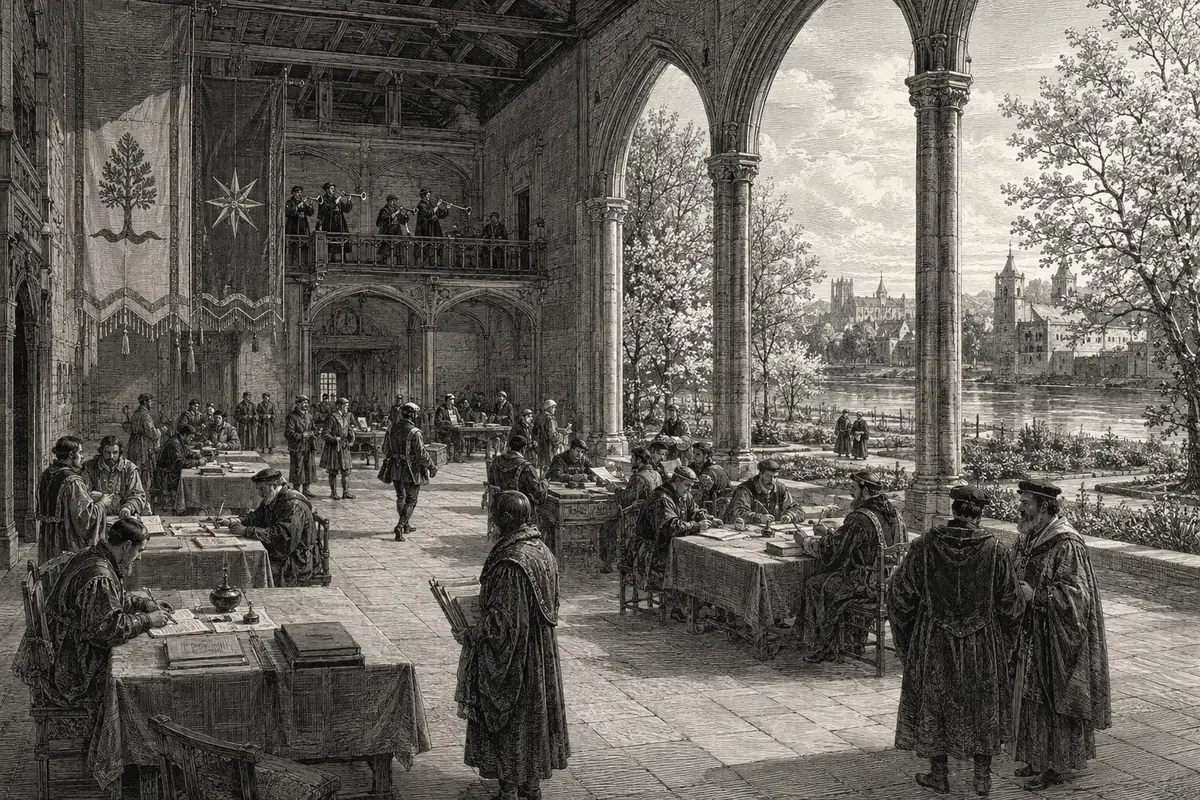
The west orangery contained no oranges.
It contained empty planters, folded scaffolds, a cracked irrigation pipe, and enough dusty glass to expose anyone who stood carelessly. Nerys chose a bench below the brick service wall where the treaty-room windows could not see them. Her older court officer remained outside the door.
Theo arrived during the garden circuit carrying a signal repair case. He opened it between them. Anyone entering would find wire, bells, pliers, and two people apparently concerned with a building fault.
“Your hand,” Nerys said.
Theo had not noticed the tremor. He closed his fingers around a wire spool. “Improving.”
“Your ribs?”
“Healed.”
“Your hearing?”
The high note occupied his left ear as if summoned by mention. “Mostly.”
“Mostly is not a medical measure.”
“Nell Arden has said this in several richer forms.”
Nerys’s mouth moved. Not a royal smile. The beginning of the expression she might have used before Morrow Bend taught them caution.
“What did you do?” she asked.
“I was hoping you knew.”
“I healed you. Marr pulled me away. The bell sounded. Then every moving thing in the room changed direction.”
“Every?”
“The bell support crossed toward Baird. The door struck Marr as wind forced it open. His own movement carried him into the stone. The club left his hand. I fell, but not where his pull should have thrown me.”
“Did you cause it?”
“No.”
She answered without defense. Theo believed her and kept the belief separate from proof.
“I remember relationships,” he said. “Pressure touching structure. Weight through the floor. Your pulse. It felt as if I could hear where force wanted to go.”
“Could you choose?”
“I don’t remember choosing anything.”
“Have you felt it since?”
“Once or twice. A floorboard before someone stepped. A carriage load through a wheel. Nothing moved.”
Nerys looked at the glass roof. “Do not test it.”
“I don’t know how.”
“Curious people often discover how by harming themselves.”
“You have studied my character.”
“I watched you challenge two Examiners with a probationer’s badge.”
“The badge was not the weak part of the plan.”
“There was a strong part?”
The humor passed between them and left the danger intact.
Theo set the spool down. “Why did Marr and Baird have you?”
Nerys’s attention shifted to the door. “Elven healers have disappeared from three Charter jurisdictions. Some were registered physicians. Some practiced privately. All had an ability close enough to mine that Special Inquiry called them a connected threat.”
“How did you trace them?”
“By what stopped happening. A midwife in Caldrin missed the first birth in twenty years. A surgeon’s patients received identical cancellation notes after he vanished. Three villages began sending broken bones across a winter pass because the woman who set them had supposedly moved without taking her furniture.”
These were not royal intelligence abstractions. Empty rooms, longer roads, births attended by someone less skilled. The institution’s policy reached ordinary life through missing hands.
“We placed observers at transfer points,” Nerys continued. “Not soldiers. Clerks, drivers, people who know when a wagon weighs more than its manifest. Marr fed one observer a false route and followed the warning backward.”
“Your contact at Morrow Bend.”
“A person I endangered by trusting the pattern too early.”
“Are they alive?”
“I do not know.”
The admission changed her voice. Theo heard the cost she had not assigned to herself in public.
“You were looking for them.”
“For transfer evidence. Lorness receives no bodies, release notices, or destinations. Families receive returned letters.”
Evan’s gray packet entered the room in Theo’s memory.
“Assessment and abatement,” he said.
“Yes.”
“Do you know what abatement means?”
“I know no one we have traced has returned. That is evidence of disappearance, not yet proof of death.”
She guarded the boundary even when fear waited beyond it.
“How many?” Theo asked.
“Confirmed missing? Twelve Lorness citizens in Charter jurisdictions. Seven others who may have crossed under different papers. More Charter subjects whose families will not speak to us.”
“And alive?”
“One physician sent a phrase in a supply correction six weeks after custody. It was a habit from her clinic accounts, not a message anyone else would notice. That proves she was alive on the day the correction was made.”
“Six weeks.”
“Nothing later.”
One narrow proof against a widening absence. Theo understood why Nerys had forced the survival question into the treaty hall instead of accusing the Guard of deaths she could not yet establish.
“The new acknowledgment rule?” he asked.
“Useful.”
“You sound disappointed.”
“I sound aware that a sealed exception is a new drawer.”
“With two signatures.”
“Which is better than none.” She inclined her head. “Your unit did that.”
“Lorness asked the question.”
“And your people prevented the answer from being removed.”
The distinction mattered more to him than praise would have.
“Marr wanted names,” Theo said.
“Names of healers still hidden. Baird wanted the route used to move medical workers through ports without Guard screening.”
“A protected route.”
“Protected by people who have not consented to your knowledge.”
Theo heard the warning. “I am not asking for it.”
“You were about to.”
He had been.
“Give the evidence to Joanna Mercer,” Theo said. “Not Special Inquiry. She can open a command review and protect the chain.”
Nerys shook her head. “You trust her.”
“She has earned it.”
“From you. I do not know which office receives her sealed requests, which clerk copies them, or whether command protection survives a diplomatic demand. A good commander is not a secure route.”
“Then what is your plan? Ask for records until the Guard confesses?”
“Force every missing name into treaty minutes. Make each jurisdiction answer separately. Offer reciprocal medical inspection so refusal costs the Guard something it values. Move the hidden people while the public argument occupies Inquiry.”
Theo had mistaken her appearance at Charter House for a reveal. It was an operation with several fronts, none dependent on him.
“If the minutes force an answer, what do you do with it?” he asked.
“If a person is alive, we demand access. If dead, we demand the body and the authority used. If neither can be proved, we name the failure in every renewal negotiation.”
“That could end road and medical agreements.”
“Yes.”
“People who had nothing to do with Inquiry would suffer.”
“Yes.” Nerys did not look away. “That is why we negotiated a narrow clause before making a public charge. My ministers wanted a broader threat.”
Theo had imagined Lorness as the cleaner institution because it stood opposite Special Inquiry. Nerys declined the convenience.
“Would you have used the threat?”
“If the clause failed.”
“Even knowing the cost?”
“Especially knowing it. Otherwise it would not be leverage.”
The answer troubled him. Its honesty also made agreement possible because neither of them had to pretend protection came without victims.
“And my part?”
“Decide your own answer. Nothing else.”
That refusal mattered. She would not turn his guilt, gratitude, or curiosity into permanent service.
“How did you reach Morrow Bend?” he asked instead.
“Compromised contact. False wagon. Drugged drink. Enough of an answer to show I was not hunting Examiners in an abandoned house.”
“Their operation is now officially unauthorized.”
“Convenient for the office.”
“Rusk calls it possible impersonation or misconduct.”
“Marr knew court protocols unavailable to impostors. Baird carried current custody codes. They may have exceeded orders. They were not alone.”
“Can you prove that?”
Nerys drew one folded paper from her sleeve. She did not give it to him. The visible corner bore a transport cipher and part of a violet seal.
“Enough to force Lorness’s record demand,” she said. “Not enough to survive confiscation.”
“You removed it from Marr.”
“Yes.”
“I reported that.”
“I expected you would.”
“Why meet me, then?”
“Because Rusk will ask whether you recognize me. Because I need to know whether you believe truth is always safe in his hands.”
Theo looked down at the repair case. Copper wire crossed pliers in tidy compartments. A system designed so each tool had one place.
“The oath requires me to speak true in my record.”
“And place no rank above lives entrusted to you.”
She knew the words. Of course she did. She had heard him use them before Baird struck her.
“Are you asking me to lie?”
“No.” Nerys put the paper away. “I am telling you what a truthful identification permits. Inquiry names me as an unregistered healer. Lorness invokes immunity. The Guard denies the detention and demands the Morrow documents. Every hidden healer connected to my route becomes leverage between institutions. I cannot predict who is taken first.”
“You arranged this meeting to influence my answer.”
“Yes.”
The directness struck harder than denial would have.
“Then why should I trust you?”
“You should not trust me beyond what I have shown. I kept you alive. I removed names from men who were torturing me for them. I entered Charter House publicly because secrecy alone could not recover our missing people. I will not give you the route. I will not promise that Lorness uses every healer justly. I will not tell you what killed Marr and Baird because I do not know.”
She rested her injured wrist on the bench between them.
“That is what I know.”
Theo thought of Joanna refusing to make the fields become one. Nerys had not offered purity. She had offered boundaries.
“I will not expose your ability,” he said. “I will not ask for names. I will not promise blind trust or conceal evidence of harm you cause later.”
“Agreed.”
“If I learn the route itself endangers people—”
“Then you decide with evidence, not loyalty.”
They did not shake hands. Touch had another meaning between them now.
The court officer knocked once on the door.
Time.
Nerys stood. “One more thing. Marr saw your recruitment file.”
Theo’s hand tightened around the spool. “How do you know?”
“He asked Baird why the glass had found nothing. Baird said dormant patterns were someone else’s problem.”
“What patterns?”
“I don’t know.”
“Why didn’t you tell me first?”
“Because you would have spent the whole meeting asking about yourself.”
He wanted to object. The accuracy prevented it.
“Do not test what happened,” she said again. “And do not assume Rusk has forgotten your missing seconds.”
She left by the treaty-room door.
Theo remained long enough to make the imaginary repair plausible. He replaced a cracked bell wire that had nothing to do with their meeting.
When he returned to Signals, a black-sealed summons waited on his board.
Chief Examiner Rusk requested him in Office Four at the close of the delegation’s afternoon session.
The summons had been issued before Theo entered the orangery.
Rusk had not needed to see the meeting to prepare the question.