
Bardo · The Oath
Chapter 19
Two Seconds
Existing forces turn lethal inside the signal house, leaving Theo alive with broken ribs, missing time, and no explanation for two impossible seconds.
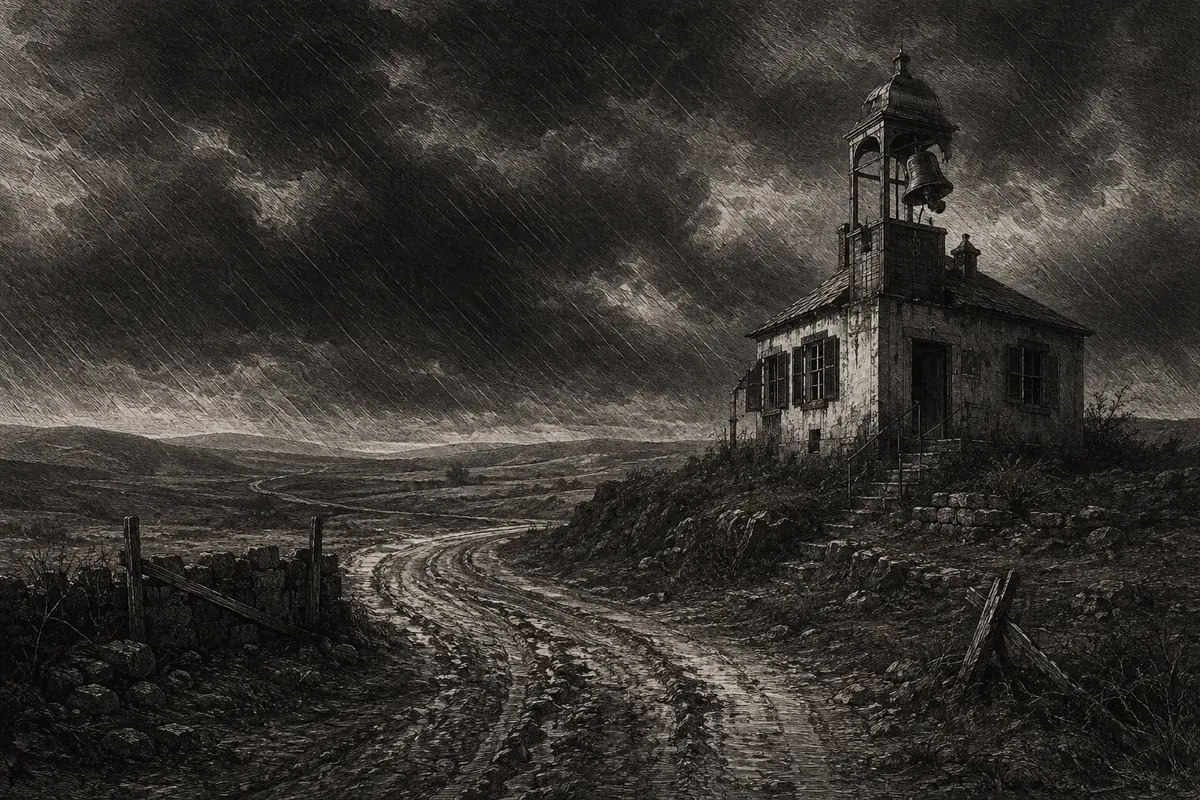
Theo remembered the bell beginning to fall.
He remembered Marr’s hand in the woman’s hair, Baird lifting the chair, rain crossing the floor beneath the loose shutter.
He remembered the bell support bending.
Then he was on his side beside the dead fire, and the room had changed.
The relay bell lay half buried in the floorboards. Its iron bracket had torn from the ceiling and crossed the room at an angle no fall could explain. Baird was pinned beneath the bracket near the wall. Marr lay by the open door with Theo’s dispatch case against his chest and the short club several feet beyond his hand.
Rain blew over both men.
The woman crouched beside Theo. Her wrists were still bound. Blood ran from one where she had forced it through the ring.
“Can you hear me?” she asked.
Theo tasted metal. “Yes.”
The word barely formed.
“Do you know your name?”
“The long version?”
She closed her eyes in brief relief. “Any version.”
“Theo.”
“Do not move.”
He moved his eyes instead.
The shutter had broken inward. One hinge was embedded in the opposite wall. A groove crossed the floor from the doorway to the bell bracket. Dust hung in the air despite rain. Every loose object in the room seemed to have traveled toward a different center.
“What happened?”
The woman looked at the bodies. “I don’t know.”
“You healed me.”
Her gaze returned to him, sharp now.
“Enough to keep you breathing.”
“That is illegal.”
“So is dying in a public signal house. We have both behaved badly.”
Theo tried to laugh. His ribs stopped him.
“How long?” he asked.
“Since what?”
“The bell.”
“Two seconds. Three.”
“No.”
“You lost consciousness.”
“Before or after?”
She looked toward Marr. “During.”
Theo searched his memory. The bell began. The room was whole. Then it was not.
The missing time had edges.
He could feel them.
The woman found Marr’s key and unlocked her wrists.
She checked both Examiners without pretending. Baird had died where the iron support struck his chest. Marr’s neck had broken; whether from the door, dispatch case, or impact against the road stone, Theo could not tell.
She forced herself to document before removing anything. Using Theo’s writing case, she sketched where each body lay, the bell bracket, shutter hinge, club, chair, and dispatch case. Her hand shook. Twice she measured distances with the signal rope and wrote them in the margin.
“You are preserving evidence,” Theo said.
“Some.”
“And taking some.”
“Yes.”
“How do I report the difference?”
“Accurately.”
She turned the sketch so he could see. “Memorize what you can. I will take the page because it contains the compartment where I found the names. You can redraw the room without that mark.”
Even now, she negotiated the boundary rather than asking him to call concealment truth.
Theo studied the positions until nausea blurred them. Bell support thirty degrees off the roof beam. Baird by west wall. Marr at threshold. Shutter hinge opposite. Groove in floor. He repeated them aloud. She corrected two distances.
“Why trust me with any of it?” he asked.
“Because you will report. Better a precise report missing one protected detail than an invented collapse.”
“You planned for my disobedience?”
“I planned around your character after watching it nearly kill you.”
“We need to leave,” she said.
“Storm.”
“Other Examiners.”
She searched Marr’s coat and removed a small ledger, two folded warrants, and a route sketch. She burned one scrap in the dead hearth using oil from the lantern. The rest she concealed inside her cloak.
Theo watched from the floor. “Evidence.”
“Names.”
“You cannot remove—”
She came back to him. “If I leave those names, the next men kill them.”
“Who?”
“People you cannot protect from that floor.”
The answer angered him because it was true and because she used truth the way Examiners used rank.
“My dispatch case.”
She retrieved it from Marr. The seal remained intact. One corner had crushed inward.
“Can you stand?”
“You said not to move.”
“The instruction has aged.”
She helped him sit.
The room turned over. Sound narrowed to a high ringing in his left ear. Nausea rose. His hands trembled so badly he could not fasten the case strap.
The woman did it. Her own fingers shook too.
“Your healing,” he said. “It harms you.”
“Strain transfers.”
“My ribs?”
“Still broken. I held your breathing and slowed the bleeding. I did not rebuild you.”
“Good. That would be administratively confusing.”
“Your institution appears experienced with confusion.”
They stood together and nearly fell separately.
Nerys found Theo’s brass token in Baird’s pocket and returned it. Blood from her wrist marked the three-low, two-high scratches.
“Evacuation?” she asked.
“Ternwick harbor.”
“You used it as a child.”
“How do you know?”
“The scratches are old, the edge is polished by a smaller hand, and you looked at it before you looked at your badge.”
Even exhausted, she read evidence because reading had kept her alive.
Theo put the token away. “What should I call you until not yet?”
“Nothing.”
“Conversation may become difficult.”
“You are capable of continuing one alone.”
He tried to smile and almost fainted.
She caught him under the unbroken side. The effort drove a tremor through her whole body.
“What did healing take?” he asked.
“Heat. Strength. Some pain.”
“My pain?”
“An echo, not a transfer of injury. Your body still owns the damage.”
“Generous.”
“Bodies are territorial.”
She made him wait while she ate two pieces of hard travel bread from Marr’s pack and drank measured water. The delay looked selfish only if one ignored that she would carry him. Theo recognized the kind of self-maintenance he habitually treated as optional.
“Your turn,” she said.
He could not swallow the bread. She soaked it and gave him pieces small enough to keep down. Care between them was practical, impatient, and stripped of romance by blood, sleet, and two bodies on the floor.
Theo leaned on her shoulder. She was stronger than her drained face suggested, but each step cost her. They crossed the room between the bodies.
At the door, Theo stopped beside Marr.
The Examiner’s eyes were open. No visible wound explained the angle of his head. The dispatch case had struck hard enough to split its leather seam.
Theo remembered force as paths. He did not remember choosing one.
“Did I kill them?” he asked.
The woman did not offer comfort. “I saw the room move. I saw you awake. I don’t know what you did.”
“I did nothing.”
“That may be true.”
It was not the same as innocence.
The road descended from Morrow Bend through pine and scrub. Rain softened to sleet before dawn.
They could not take the Examiners’ wagon because one horse had broken loose and the other would not approach the house. Theo’s field horse had pulled its lead and gone. They walked.
At the first bend, Nerys left the road and returned by another line to inspect their tracks.
“What?” Theo asked when she rejoined him.
“You drag the right foot when the rib catches. I step shorter after healing. Anyone following can identify both.”
She broke a pine branch and brushed the worst impressions, then directed them over stony ground. The detour cost Theo breath. It also meant the Examiner courier later saw only storm-softened traces at the road.
“You have done this before,” he said.
“Avoided pursuit?”
“Moved people.”
“Medical workers cross borders that prefer their skills in one direction. Routes are part of care.”
The statement joined healing to maps, drivers, food, false names, and people who maintained paths. Nerys’s ability could stabilize one body. Her real work involved systems.
The woman kept them off the road where possible. She knew how to read wheel ruts, where to cross a ditch without leaving a clean slide, how to bind her bleeding wrist using cloth cut from the expensive lining rather than the visible cloak.
“You are not an ordinary traveler,” Theo said.
“You noticed the embroidery.”
“I notice tailoring under interrogation.”
“A specialized education.”
“Avelos House receives merchants who pretend their sleeves cost less than they do.”
She glanced at him. “Avelos. Ternwick harbor charter.”
“You know the family?”
“I know which houses can move medicine through a port without calling it diplomacy.”
He wanted to ask her name again. He also understood that answers created custody. Examiners had wanted names and routes. Theo wore the same bridge they did.
“There is a supply road two miles south,” she said. “Carts reach it after sunrise.”
“How do you know?”
“I prepared routes.”
“For what?”
“Survival.”
His next step jarred the broken rib. The world flashed white. When it returned, he was kneeling in sleet.
She put a hand near his shoulder, then stopped before touching him.
“I cannot heal you again,” she said.
“I didn’t ask.”
“Your face did.”
“My face lacks discipline.”
She helped him up without using the ability.
At the supply road, they waited behind a stone wall until a wagon approached carrying lamp oil and flour. The driver was an older woman with a crossbow under the seat.
Before the wagon came, hoofbeats sounded from the north.
The woman pulled Theo down behind the wall, one hand over the white bridge at his collar. A rider passed at speed wearing a dark oilskin. No insignia showed, but the horse carried the close-shod tread used by Examiner couriers.
Theo reached for his whistle.
She caught his wrist. “If that is Guard, you get help. I get Marr’s replacement.”
“If it is a road rider, we lose help.”
“Choose.”
He listened to the hoof rhythm diminishing south. One rider. No wagon. No medical bell. Calling would identify their position before anyone could answer.
Theo let the whistle remain silent.
The choice felt different from Morrow Bend. He knew who carried the immediate cost: both of them, waiting injured in sleet. No unseen teammate would run toward his signal.
They heard the supply wagon ten minutes later.
“Road is closed north,” the stranger called. “Turn around.”
“Guard injured,” the young woman answered.
“I see the coat.”
“See the breathing.”
She stepped aside. Theo tried to stand straight and failed.
The driver looked at the blood, the broken dispatch case, and the woman with bound-wrist marks.
“What happened?”
Theo opened his mouth.
The woman said, “Signal house collapsed in the storm. Two officers dead. He needs a clinic. If you want a cleaner story, wait until he can lie sitting down.”
The driver considered this, then set the crossbow farther from her hand.
“Get him in.”
The woman persuaded her to take the western fork to a rural clinic rather than the Guard post. “Ribs first,” she said. “Reports after.”
Theo was too weak to object well.
He lay among flour sacks while the wagon moved. The young woman sat near the tailboard, watching the road behind. Dawn found blue in the hidden embroidery at her torn cuff.
“Your name,” Theo said.
“Not yet.”
“Will there be a later?”
“If your Guard does not make one impossible.”
The ringing in his ear grew louder. He closed his eyes for one moment.
He woke in a whitewashed room with three ribs bound, a pounding head, and no woman.
A clinic physician sat beside the bed writing a list of injuries.
“Your companion left after we admitted you,” she said. “Paid the driver with a gold piece too heavy for local mint.”
“Did she give a name?”
“No.”
“Description?”
The physician looked at his Guard collar on the chair. “For your report?”
Theo remembered bound wrists. Names burning in a dead hearth. Marr’s authorization in violet wax.
“For mine,” he said.
The physician set down her pen. “Young. Elven. Exhausted. Educated. More frightened for you than she wanted anyone to see.”
Theo stared at the ceiling.
“Two men are dead at Morrow Bend,” he said.
“The driver told the road watch. Your people are coming.”
He raised his left hand. Tremor moved through the fingers. A high tone occupied his ear. When the physician crossed the room, the floorboard creaked and Theo’s body flinched as if he could feel where her weight would travel.
Then the sensation was gone.
Between the bell beginning to fall and the broken room lay two seconds he could not enter.
The unidentified woman had taken her name.
The missing time had taken everything else.